🏴 Husayni Mourning Around the World – 2026
🌐 77. Sierra Leone:
Ashura International Foundation / Husayni Mourning News:
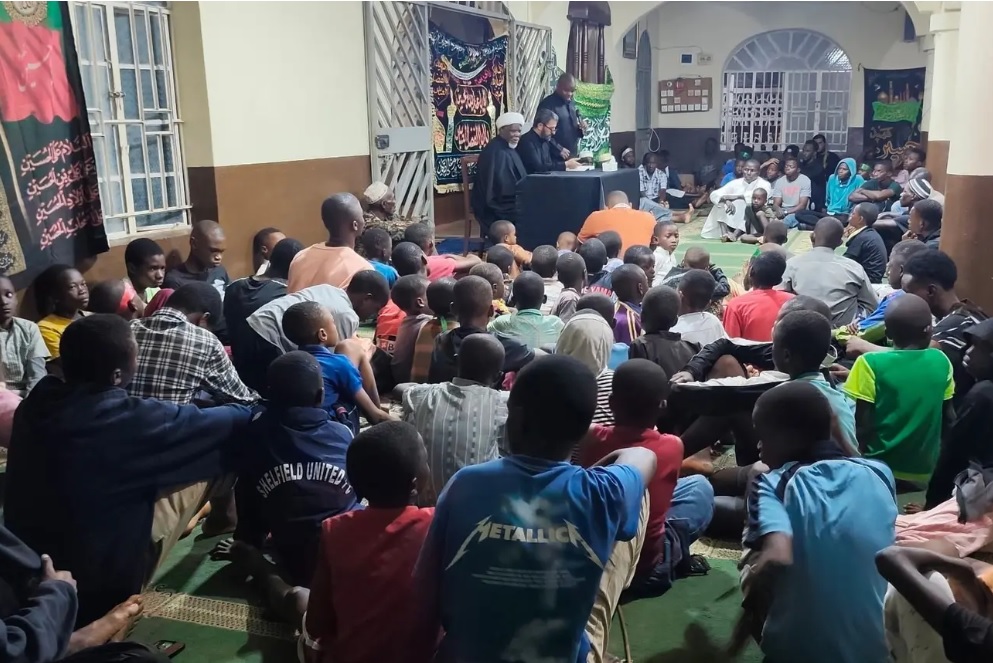
On the occasion of the arrival of Muharram, a commemoration ceremony mourning the martyrdom of Imam Husayn (a.s.) and his loyal companions was held with the cooperation of Iran’s Cultural Attaché and hosted by our country’s embassy in Freetown, the capital of Sierra Leone.
Concurrent with the arrival of the days of mourning for Imam Husayn (a.s.), the Shiite mosque in Freetown, “Mosque of the Great Messenger (p.b.u.h.),” witnessed a ceremony with the widespread presence of the devotees of the AhlulBayt (a.s.), displaying a manifestation of the deep connection of the Shiite community in West Africa with the culture of Ashura and the ideals arising from the Husayni movement.
Abedin Siyahat-Esfandiari, the Cultural Attaché of the Islamic Republic of Iran, in his speech, elaborated on the epistemological and civilizational dimensions of the Ashura uprising and the significance of standing against oppression and tyranny.
Referring to the fact that Muharram is not merely a month of tears and mourning but rather a month of awakening, dignity, and the revival of human conscience, he emphasized: The school of Imam Husayn (a.s.) is a school for cultivating free and resilient human beings, and the message of Ashura is not limited to a specific time and place, but is a living and ongoing truth throughout history.
Siyahat-Esfandiari, by depicting the scene of the afternoon of Ashura and expressing the heart-wrenching tragedies of the AhlulBayt (a.s.), called upon the audience to reflect on one of the most profound moments in Islamic history, and addressed the historical statement of Lady Zaynab al-Kubra (s.a.) after the Ashura event—a statement in which, in response to the enemy’s mocking question, she declared with firmness and certainty, “I saw nothing but beauty.”
The Cultural Attaché of Iran, emphasizing that true peace is different from outward comfort, noted: A person may be in the most difficult outward circumstances, yet due to being on the path of truth and fulfilling their divine duty, they may possess a deep and lasting peace—the same peace that Imam Husayn (a.s.) possessed on the noon of Ashura and Lady Zaynab (s.a.) possessed at the height of captivity and tribulation.
Stating that Karbala is not merely a geography but rather the eternal front of truth and falsehood, he added: Ashura has not ended, and today, wherever an oppressed person stands against oppression and preserves their dignity and honor, the spirit of Ashura is alive.
Siyahat-Esfandiari, referring to the suffering of the Palestinian people, described the resistance of the Palestinian nation as a manifestation of the continuation of the message of dignity and freedom, and added: The steadfastness of the oppressed Palestinian people, despite all pressures and hardships, is reminiscent of the eternal message of Ashura and the spirit of resistance against oppression.
Abedin Siyahat, the Cultural Attaché of the Islamic Republic of Iran in Sierra Leone, attended the Friday prayer ceremony at the central mosque in Freetown.
Prior to the Friday prayer ceremony, the Cultural Attaché met and held talks with Sheikh Muhammad Ramadan Bah, the Friday prayer leader of the central mosque in Freetown and the head of the mosque’s imams. Sheikh Muhammad Ramadan Bah emphasized the necessity of expanding cultural and religious cooperation between the two countries.
The Friday prayer leader, given the arrival of Muharram, dedicated the main theme of his sermons to explaining the historical background of the Ashura movement and the necessity of properly understanding the Karbala event.
He stated, “Understanding the historical roots of Ashura is not merely the study of a historical event, but rather a window into a deep understanding of concepts such as justice, freedom, social responsibility, the fight against oppression, and the protection of human dignity.”
Sheikh Muhammad Ramadan Bah, also referring to the exalted status of Sayyed al-Shuhada (a.s.) (the Master of Martyrs) with the Holy Prophet (p.b.u.h.), emphasized the necessity of drawing lessons from the teachings of Ashura in the individual, social, and political lives of Muslims, and said: “A society that makes the culture of sacrifice, honesty, resistance, truth-seeking, and responsibility its guiding principle will be more resilient against deviations and social harms.”
Short link
Questions and Comments