🏴 Husayni Mourning Around the World – 2026
🌐 95. Myanmar:
Ashura International Foundation / Husayni Mourning News:
The commemoration of Muharram is, of course, not limited solely to Shiites. It is not even limited to Muslims alone; various religions and ethnic groups hold ceremonies during this month, especially during its first ten days, which have manifested an eternal image of the perpetual battle between good and evil throughout all these fourteen centuries. Whether it is the ceremony of the Armenians of Iran, who wear black during the first ten days of Muharram out of respect for their compatriots, or the Zoroastrians who consider Imam Husayn (a.s.) as the son-in-law of the Iranians; and of course, the commemoration of this month in various countries around the world, even in countries whose dominant official systems do not have good relations with divine religions.
Although Muslims constitute a very small minority in Myanmar, they hold Ashura ceremonies in their own manner, yet with remarkable grandeur. This is also more or less the case in other East and Southeast Asian countries, where the people hold magnificent mourning ceremonies for Imam Husayn (a.s.) and his loyal companions during Muharram.
In the country of 75 million people, Myanmar, which has about 300,000 Muslims, we witness mourning ceremonies for Imam Husayn (a.s.) every year. In this country, although the majority of Muslims are Sunni, numerous speeches and mourning ceremonies are held during the months of Muharram and Safar.
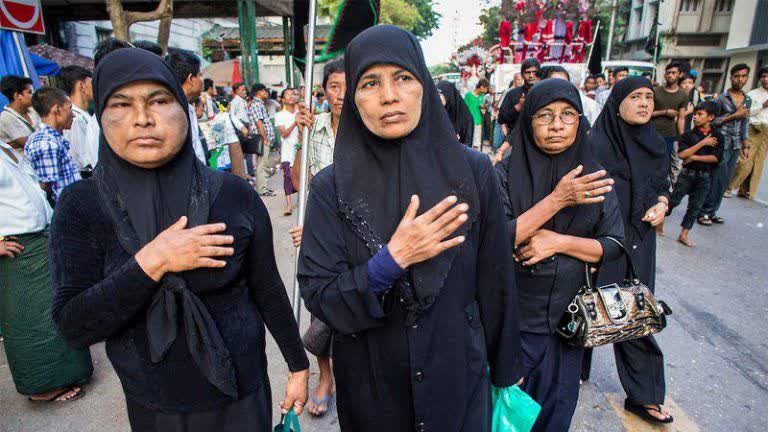
Shiites in this region of the world observe specific rules, laws, and customs during Muharram. For example, during this month, Shiites attend the streets and their workplaces wearing black clothing, do not marry, and do not buy new clothes. Muslim women in this land also refrain from any kind of makeup.
In this country, Shiites hold magnificent ceremonies in the cities of Yangon (Rangoon), Mandalay, and Pyay (Prome), which are among the most enduring and influential mourning traditions and rituals. These ceremonies, held during the first ten days of Muharram in over 30 mosques, Imam Baras, Imam Bargahs, and shrines, are so passionate that they even attract Buddhists and Sunni Muslims. At these ceremonies, standards (alam) and canopies (katel) covered with flowers and black and green fabrics, as well as coffins and Dhu al-Janah (the symbolic horse of Imam Husayn), are carried.
Such magnificent ceremonies are held in Shiite-populated areas of Myanmar under conditions where these Shiites have always lived under severe pressure, especially in recent years, from some racist Buddhists. Particularly the Shiites of Rakhine State, who live on the front lines of the struggle between the Rohingya and Buddhist extremists. In this land, where one of the most familiar images is the burning of Muslims, the destruction of mosques, and the burning of the Quran, the annual commemoration of Ashura is the best testament to the survival of the anti-oppression message of Imam Husayn (a.s.) and his companions after fourteen centuries.
Short link
Questions and Comments