
🏴 Husayni Mourning Around the World – 2026
🌐 India:
Ashura International Foundation / Husayni Mourning News:
The Musta’li Ismailis, known as “Bohras,” place great emphasis on mourning ceremonies for the Master of Martyrs, Imam Hussein (a.s.), and like Twelver Shiites, hold passionate gatherings to commemorate his sacrifice. Additionally, the Bohras have a particular dedication to visiting the tombs of the Imams and have made significant efforts in the reconstruction and restoration of the holy shrines (Atabat). The Mosque of Kufa in Iraq is one example of a site restored by the Ismaili Bohras, whose architecture is also derived from Bohra architectural traditions.
Bohras around the world commemorate the martyrdom of Imam Hussein (a.s.) during the first ten days of Muharram, believing it to be a source of blessing and a means of spiritual purification. For this reason, these ten days are designated as “Mubaraka” (the Blessed Ten).
Like millions of Muslims around the world, the Dawoodi Bohra community, under the guidance and leadership of the 53rd al-Dai, Mufaddal Saifuddin, dedicates these days to the remembrance and elegy of Imam Hussein (a.s.), seeking blessings from this profoundly spiritual event. For the Dawoodi Bohra community, Ashara Mubaraka is akin to a spiritual, educational, and material journey toward growth and development.
Every Dawoodi Bohra community center around the world hosts this event for its local congregation with a series of assemblies held twice daily—once in the morning and once in the evening. In the morning assembly, the orator delivers a sermon, while the evening assembly typically consists of collective elegy recitation, in which all those gathered for the occasion participate.
As each day’s exploration of Islamic history and philosophy unfolds, the narrative of Imam Hussein’s (a.s.) journey to Karbala is recounted in greater detail as the assemblies draw closer to Ashura. Community members close their shops and take leave from schools to attend these gatherings. In this way, individuals commit themselves to holding this memorial as a tribute to the sacrifice of Imam Hussein (a.s.).
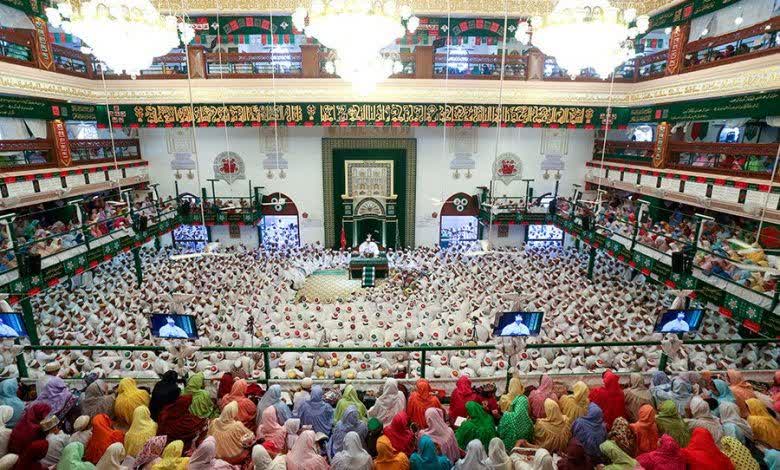
The largest gathering within the Dawoodi Bohra community takes place at the venue where Mufaddal Saifuddin, the head of the Dawoodi Bohra community, leads the commemorations.
The Ashara Mubaraka assemblies, led by Mufaddal Saifuddin himself, are held on a grand scale and offer a truly unique experience for the tens—and sometimes hundreds—of thousands who attend. Over these ten days, Mufaddal Saifuddin delivers ten sermons in which he recounts the hardships and tribulations of Imam Hussein (a.s.) and expounds upon the courage and fortitude of the Imam, his family, and his companions. The memory of Imam Hussein (a.s.) is intrinsically linked to Islamic history and philosophy, which Mufaddal Saifuddin elucidates in his sermons. He ultimately connects these themes to contemporary life, bridging thousands of years of Islamic history with the issues facing the Bohra community and humanity today. The sermons serve as a means for community members to renew their faith and navigate the complexities of modern life.
His presence, the influx of thousands of visitors, and the coordination and cooperation with local, state, and national government bodies strengthens the standing of the local community in that city. As the event is replete with spiritual, economic, cultural, and social impacts, cities compete for the honor of hosting it. Written and oral petitions from host cities often begin months before Muharram, during major community events, and they present reports of their preparations and planning to Mufaddal Saifuddin.
One aspect of the Ashara Mubaraka ceremonies that requires the most logistics and is perhaps the most symbolic event is the “Ma’id” (from *ma’idah*—a table spread with food). Ma’id is an Arabic word meaning platters laden with food, and it is used as the name for large dining venues where thousands of guests partake in communal meals. Despite the enormous resources required and the nearly daunting logistics, breakfast, lunch, and dinner are served daily to thousands of people within the span of a few hours.
Short link
Questions and Comments