🏴 Husayni Mourning Around the World – 2026
🌐 22. Iraq:
Ashura International Foundation / Husayni Mourning News:
The Husayni Processions Board of Najaf Province announced the widespread presence of hundreds of processions (mawkibs) to provide services to pilgrims and hold mourning rituals.
Zaki Jarbu, the head of the Husayni Processions Board of Najaf, announced that this year 870 Husayni processions will participate in the Ashura mourning ceremonies.
He added: The Husayni processions, especially the service processions, offer a wide range of services including accommodation, hospitality, food provision, and other essential needs of the pilgrims, in order to provide suitable conditions for the grandest possible observance of Husayni rituals.
Jarbu stated that out of the active processions, 460 are service processions, 215 are traditional mourning processions (Azwa), 105 are chain-beating processions, 75 are torch processions, and 15 are “Mashq” processions participating in this year’s Muharram programs.
He also emphasized that the planning for the departure and movement of the processions and their entry into the holy shrine of Amir al-Mu’minin Imam Ali (a.s.) is carried out in coordination between the Husayni Processions Board, the Holy Alawi Shrine, and the Najaf Police Command, in order to facilitate the movement of pilgrims and mourners with greater order and ease.
*The Torch Procession Ritual; A Tradition of Over a Century
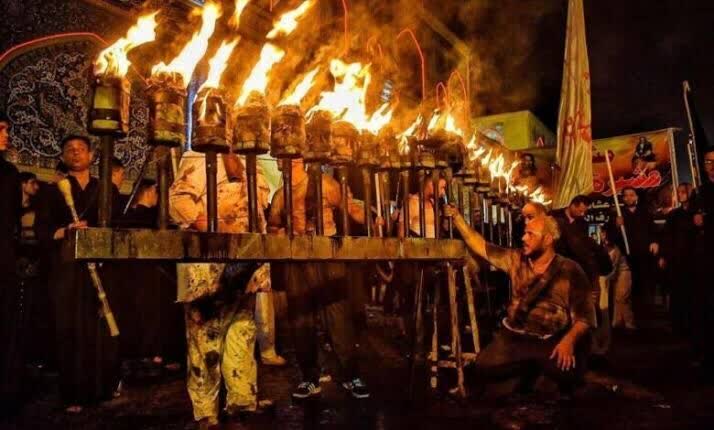
Ali al-Miyali, one of the officials of a torch procession, stated in this regard, “Torch processions are considered among the most prominent Ashura rituals in Najaf, held every year on the nights of the 8th, 9th, and 10th of Muharram.”
He explained that during this ceremony, mourners move toward the holy shrine of Imam Ali (a.s.) carrying lit torches, and the city’s atmosphere is filled with the sounds of drums, chest-beating, and scenes of Ashura mourning.
Al-Miyali emphasized that this ritual symbolizes the remembrance of the burning of the tents of Imam Husayn (a.s.) and his AhlulBayt (a.s.) after the Karbala event, embodies the oppression of the women and children of the Husayni caravan, and also represents a renewal of allegiance to the ideals of Sayyed al-Shuhada (a.s.) (the Master of Martyrs).
He added: The torches are usually made of wooden or metal poles, with containers at the top for lighting the fire. The torch bearers are chosen from among selected individuals from the tribes and families of Najaf and receive the necessary training before the ceremony.
Al-Miyali, referring to the history of this tradition, stated: According to historical accounts, the first torch procession was held in Najaf in 1914 AD, and this ritual has been passed down from generation to generation since then, becoming one of the main symbols of Ashura mourning in this city.
The Hospitality of the People of Najaf; An Enduring Tradition
Aqil Mohsen, another owner of a Husayni procession, also stated that preparations to welcome pilgrims begin from the first day of Muharram and continue until the end of Safar.
He said: The homes of the people of Najaf are opened to pilgrims during these days, and citizens, alongside the processions, participate in providing various services to the mourners.
Mohsen described serving the pilgrims of Imam Husayn (a.s.) as a great honor for the people of Najaf and added: The processions of this city every year host pilgrims from various Iraqi provinces, including Basra, Dhi Qar, and Muthanna, and provide them with accommodation, food, and other necessary services.
He emphasized that this hospitality is not limited to the days of pilgrimage; rather, in many cases, it has developed into lasting social relationships and friendships among Iraqi families from different regions of the country, symbolizing solidarity and empathy among the Iraqi people.
Concurrent with Ashura, millions of pilgrims from within and outside Iraq head to the holy cities of Najaf and Karbala to commemorate the anniversary of the martyrdom of Imam Husayn (a.s.) in the Karbala event, and the mourning rituals in these two cities reach their peak.
Short link
Questions and Comments