🏴 Husayni Mourning Around the World – 2026
🌐 85. Turkey:
Ashura International Foundation / Husayni Mourning News:
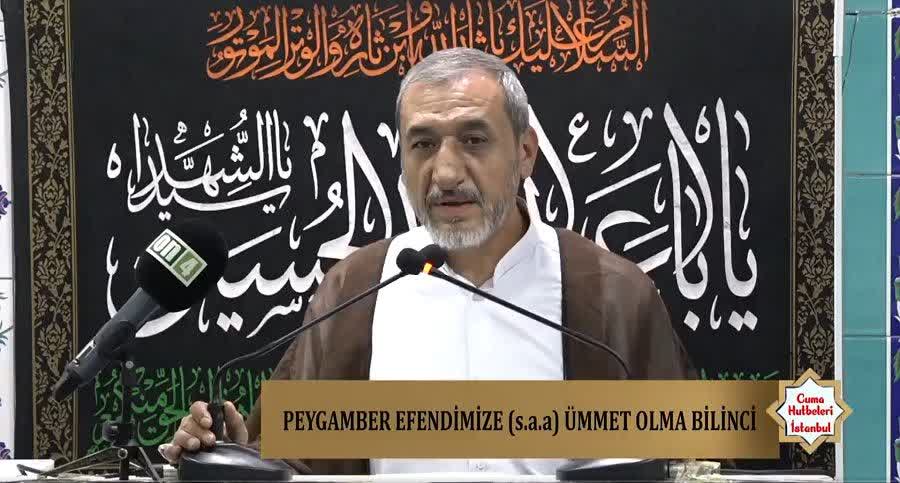
Hojat al-Islam Sheikh Kadir Akaras, Head of the AhlulBayt (a.s.) Scholars Union of Turkey (Ehlader), in an essay looking beyond geographical borders, revisited the global manifestations of the Ashura ceremonies of 2026 (1447). Emphasizing the globalization of the message of Imam Hussein’s (a.s.) movement, he described Ashura as the shared heritage of human conscience and Karbala as a universal language for justice, freedom, and human dignity.
The full text of this essay is as follows:
The Borderless Voice of Karbala
Every year with the arrival of the month of Muharram, the world grows a little quieter. But this silence is not the silence of death; it is a state of tranquility in which conscience speaks and hearts listen. Because Karbala is not merely a day on the calendar; it is an echo in the conscience of humanity that never fades.
The Ashura ceremonies of 2026 (1447) once again revealed this truth before all eyes. This year, not only in Karbala, Najaf, Qom, or Mashhad, but from Istanbul to London, from Berlin to New York, and from Karachi to Sydney, millions of people around the world came together around a shared mourning. Geographies differ, languages differ, and cultures differ, but the language of tears has never changed.
The surging tide of millions of pilgrims in Iraq was not merely a manifestation of historical attachment, but a symbol of living faith. In Iran, in the shadow of the martyrdom of the beloved Leader and war, centuries-old traditions found a new connection with the rhythm of modern cities. In Pakistan and India, despite security concerns, the people’s determination to keep alive the love for Hussein (a.s.) was admirable. In Lebanon, elegies recited despite the savagery of the Zionist occupiers and all the brutalities of war—and memorial ceremonies that had transformed into a display of power—brought back to the field the Husayni spirit present in the resistance that bombs could not extinguish in Palestine.
Europe, however, presented a different landscape this year. The marches held in London, Berlin, Hamburg, and other major cities were no longer merely intra-community mourning programs of immigrant communities, but appeared to have taken on global dimensions. Karbala’s message clearly reflected the reality that it is becoming a universal language around the concepts of “justice,” “freedom,” and “human dignity,” observed with curiosity by people of different religions and nations.
In the United States as well, despite the crowded World Cup fervor, programs held in cities such as New York, Los Angeles, Chicago, and Houston were not limited to mourning gatherings. Blood donation campaigns and relief activities for the needy demonstrated to the entire society that Karbala is not merely a fountain of tears, but simultaneously a school of mercy and social responsibility.
In Turkey, too, a notable aspect of the programs held—particularly in Istanbul, Ankara, Iğdır, Kars, and many other cities—was the convergence of different Sunni groups in a shared spiritual atmosphere.
The sorrowful love of the Anatolian people, intertwined with affection for the AhlulBayt (a.s.), combined with remembrance by vast crowds, created a beautiful atmosphere that encompassed all segments of society—from the ruling party to opposition parties—uniting them in a shared mourning. Young people walking in black garments alongside elderly men dressed in black were now transmitting to the future, in their own language, the Karbala that their grandfathers had narrated. This was not merely the continuation of a tradition, but the entrusting of historical memory from one generation to the next.
However, what made me ponder most deeply in this year’s ceremonies was not the magnitude of the crowds. The main question that must be addressed is:
Is the remembrance of Karbala expanding, or is the understanding of Karbala?
Remembering Imam Hussein (a.s.) solely through weeping is easy; what is difficult is living according to the truths for which he stood up. In this regard, the updating of Karbala’s message and the transformation of ceremonies into a tangible reaction against oppressors were encouraging.
Today, oppression continues on earth; oppressed children still weep. The fact that hunger, war, occupation, and injustice remain a shared shame of humanity necessitates the adaptation of Karbala’s message to our age.
If those who return from the fields of Ashura do not become more just in their workplaces, more compassionate in their families, more honest in their societies, and more courageous in the face of oppressors—both individual and societal—then Karbala’s message has not yet fully penetrated hearts. Because Karbala is not merely an event to weep over; Karbala is a moral school that teaches not remaining silent before the oppressor.
Another reality that drew attention this year was the globalization of mourning culture in the age of communication.
In the past, people could only participate in ceremonies in their own cities, but today they can follow programs from around the world simultaneously. An elegy recited in one city resonates on another continent just minutes later. The water distributed by a child sets hearts beating thousands of kilometers away.
It is as if that call of “Is there anyone to help me?” (Hal min nasirin yansuruni?) that echoed on the banks of the Euphrates centuries ago has now traversed fiber optic cables and is once again reaching all of humanity. Perhaps this is the greatest miracle of Ashura.
Despite fourteen centuries having passed, neither have the oppressors been forgotten, nor has the voice of the oppressed been silenced. Monarchies have been relegated to the dusty shelves of history, many empires have collapsed, but the red flag of Karbala still waves everywhere in the world. Because truth is kept alive not by the sword, but by conscience. And the life of conscience outlasts that of states.
The Ashura ceremonies of 2026 (1447) once again showed us that Karbala no longer belongs to a specific geography, but is the shared heritage of human conscience. Wherever there is an oppressed person, the name of Hussein will be remembered there again. Wherever a human being pays a price for justice, Ashura will be experienced there again. Because Karbala is not a battle left in history; it is the call of morality and uprising addressed to the human being of every era.
And that call today is as alive as it was on the first day:
“Will a human being stand with the oppressor, or with the truth?”
Short link
Questions and Comments