
🏴 Husayni Mourning Around the World – 2026
🌐 Germany:
Ashura International Foundation / Husayni Mourning News:
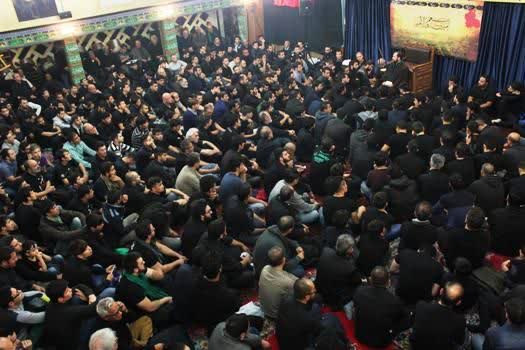
Every year, Ashura mourning ceremonies are held at the Islamic Center of Hamburg with the participation of a large number of people.
Until the early 20th century, most Muslims residing in this country consisted of merchants, students, and travelers. After World War I, a group of Muslim soldiers and officers from the involved armies remained in Germany. Along with migrants who came from Muslim regions of Russia after the 1917 Russian Revolution, they increased the number of Muslims in this country. After World War II, approximately five thousand Muslims from the former Soviet Muslim regions such as Turkmenistan, Azerbaijan, the Caucasus, and the northern Volga region migrated to this country; subsequently, with the arrival of Turkish and Yugoslav Muslims to West Germany, the number of Muslims in this country gradually increased significantly.
According to the latest statistics, the number of Turkish Muslim workers residing in West Germany in 1984 was 1.6 million.
The number of Muslim students reached 15,000 by the late 1970s. Another segment of Muslims in this country consists of merchants.
Today, according to German sources themselves, nearly two million Muslims live in the Federal Republic of Germany.
*Shiites in Germany
A large number of Muslims residing in Germany are Shiites, mostly living in the cities of Frankfurt, Munich, Aachen, Hanover, and Hamburg.
Among these, the largest Shiite Muslim community resides in Hamburg. Until 1979, between seven and fifteen thousand Iranians lived in West Germany.
The first mosque built in Germany was the “Schwetzingen Mosque,” constructed in 1780 in the Schwetzingen Park in Berlin.
This mosque was built by a German prince who married a Turkish woman and converted to Islam. Currently, Eid al-Fitr and Eid al-Adha prayers are held at this mosque.
In 1953, at the request of a group of Iranian Shiites residing in Hamburg, the late Grand Ayatollah Sayyed Hossein Tabatabai Borujerdi agreed to the construction of a mosque in that city. The foundation stone of this grand mosque, which later became known as the “Islamic Center of Hamburg,” was laid in the middle of Sha’ban in 1959 on a plot of 3,774.4 square meters in the best location of Hamburg, beside Lake Alster, by Hojat al-Islam Mohammad Mohagheghi, the representative of the late Grand Ayatollah Borujerdi, with the presence of a large number of Muslims, city dignitaries, and German orientalists.
Since 1965 (1344 AH), the University of Cologne in Germany has established a center called the Research Center for Shiite Sciences and Doctrines, which has so far collected over 8,000 volumes of Shiite books, including jurisprudence, principles of jurisprudence, theology, biographical evaluation, philosophy, history, literature, and more. Since 1968, special attention has been paid to Shiite doctrines in Germany, and in a short period, numerous books and articles by German scholars such as Professor Erwin Gräf have been published.
Every year, Ashura ceremonies are held at the Islamic Center of Hamburg with the participation of a large number—over two thousand people.
The number of Shiite and Sunni Muslims in the city of Hamburg is between 80,000 and 100,000, and throughout Germany up to two and a half million.
Over the years, both before and after the Islamic Revolution, a large number of people, solely out of love for Imam Hussein (a.s.) and the AhlulBayt (a.s.), attend the Islamic Center of Hamburg on the two days of Tasu’a and Ashura.
On the days of Tasu’a and Ashura, the ceremonies at the Islamic Center mostly consist of speeches and, at the end, mourning and chest-beating, and are less mixed with superstitions. However, in the basement level, every year during the first ten days of Muharram, Pakistani Muslim brothers and sisters, whose number perhaps reaches two hundred, hold mourning ceremonies with effigies and reenactments, which are more traditional and less historical.
In Hamburg, the Ashura ceremony remains alive.
Author: Hojat al-Islam Dr. Abdolkarim Bi-Azar Shirazi
Short link
Questions and Comments