🏴 Husayni Mourning Around the World – 2026
🌐 46. Azerbaijan:
Ashura International Foundation / Husayni Mourning News:
In the not-too-distant past, the holding of any religious and Islamic rituals, particularly during the month of Muharram, was prohibited in the Muslim-populated regions of the former Soviet Union, including the Republic of Azerbaijan.
The communist regime of the former Soviet Union, which viewed Islamic beliefs and values as a threat to Marxist ideals, severely suppressed such ceremonies. However, after 70 years, following the collapse of the Soviet Union and Azerbaijan’s independence in 1990, the return of the country’s Shiite population to authentic spiritual values rooted in pure Muhammadan Islam became possible.
Of Azerbaijan’s total population of eight million, over 93 percent are Muslim, of whom 75 percent are Ja’fari Shiites—a reality that had consistently caused concern for the rulers of the former Soviet Union. They resorted to confiscating Islamic books and eliminating Islamic preachers to mitigate their political challenges, and in the early years of the communist regime in Azerbaijan, they eliminated most prominent clerics, while a number of others, facing threats, sought refuge in Iran, Turkey, and other Islamic countries.
During the 70-year rule of the communist regime in Azerbaijan, all mosques and religious centers in the country were either destroyed or closed, and in some areas, mosques were converted into food storage warehouses.
Although the holding of any religious ceremonies in Azerbaijan—particularly in Baku—was strictly prevented during this period, the people, especially the elderly, secretly performed religious rituals.
Although the communist regime of the former Soviet Union had made the fight against the spread of religious values in Azerbaijani society a top priority, the Muslim people of this region, learning from the school of Islam and the epic of Imam Hussein (a.s.), passed these traditions from chest to chest and generation to generation. For this reason, the regime never fully succeeded in preventing certain religious ceremonies, particularly Husayni mourning during Muharram. People even spontaneously held special rituals for Tasu’a and Ashura in some neighborhoods and areas, during which they were subjected to attacks and harassment by security forces.
During the Soviet era, Husayni mourning was held—though secretly—in areas on the outskirts of Baku, particularly in the religious town of Nardaran, in border districts with Iran including Lankaran, Astara, Masally, Yardimli, Bilasuvar, Jalilabad, Lerik, and also in Nakhchivan, with the participation of large numbers of people.
During that period, people held mourning ceremonies in their homes with neighbors from the first of Muharram until the day of Ashura.
With Azerbaijan’s declaration of independence and the reopening of mosques, Husayniyyahs, and other religious centers in the country, religious ceremonies—particularly Husayni mourning—are now held extensively. This process demonstrated that despite all the efforts and measures of the communist regime, the people remained steadfast in their religion and preserved it in their hearts.
In the early years of Azerbaijan’s independence, Husayni mourning ceremonies, especially Ashura, were held on a wider scale in public thoroughfares, which caused concern among some secular and Western-oriented circles, leading to the imposition of certain restrictions. At present, mourning ceremonies are held throughout the country in mosques and Husayniyyahs, and the widespread and passionate participation of young people is a distinctive feature of these rituals.
Now, unlike in the past, wedding celebrations are not held at all from the beginning of Muharram until the Arba’een of Hussein in Azerbaijan, out of respect for Imam Hussein (a.s.) and the other martyrs of Karbala.
While Azerbaijani media—particularly outlets aligned with Western-oriented circles—were not initially inclined to cover Husayni mourning ceremonies in the early years of independence, they now publish content on these events due to the growing public attention to these rituals and spiritual values.
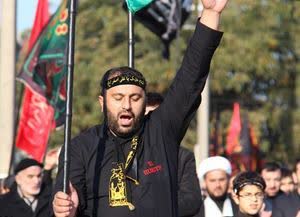
Husayni mourning, especially on Tasu’a and Ashura, is held extensively in mosques, Takayas, and Husayniyyahs across the Republic of Azerbaijan. In these rituals, Muslim mourners engage in chest-beating and lamentation in memory of the Ashura epic, and eulogists of the AhlulBayt (a.s.) recite elegies in praise of Imam Hussein (a.s.) and his 72 loyal companions, infusing the mourning gatherings with fervor and emotion.
Although in recent years there has been considerable debate in Azerbaijani society regarding the legitimacy of chest-beating and chain-beating in Husayni mourning ceremonies, most believe that these rituals should be conducted appropriately and in a manner befitting the exalted status of Imam Hussein (a.s.) and his faithful companions. In this regard, members of the religious council of Baku’s Juma Mosque have for several years donated blood on Ashura for patients and those in need.
This religious initiative, which has become common on Ashura, has been welcomed by the Caucasus Muslims’ Spiritual Administration of the Republic of Azerbaijan, which annually calls on devout individuals to refrain from bloodshed and chain-beating.
Meanwhile, the mourning ceremonies of Iranians in Baku have always drawn attention. Devoted lovers of Imam Hussein (a.s.) hold special mourning rituals with indescribable fervor at Husayniyyahs in Baku, and large numbers of Azerbaijani people—mostly young—eagerly participate in these ceremonies. The presence of prominent Iranian eulogists and orators also plays a significant role in the widespread holding of these ceremonies and in raising awareness about the event of Karbala and its tragedies.
Short link
Questions and Comments