🏴 Husayni Mourning in the World – 2026
🌐 73. Qatar:
Ashura International Foundation / Husayni Mourning News:
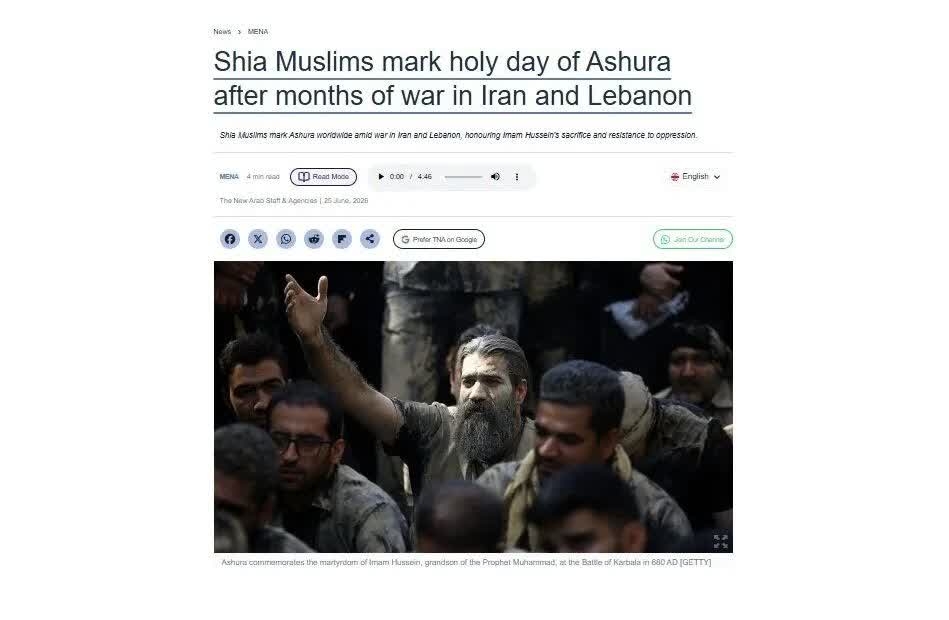
Al-Arab Al-Jadeed reported in its coverage that Shiites around the world held Ashura mourning rituals last Thursday, corresponding to June 25, 2026—a sacred day symbolizing sacrifice and martyrdom in Shiite culture, which this year, for many Shiite communities, has taken on special significance following months of war in Iran and Lebanon.
The outlet, explaining the occasion, wrote: Ashura commemorates the martyrdom of Imam Hussein (a.s.), grandson of Prophet Muhammad (p.b.u.h.), at the Battle of Karbala in 680 AD. Imam Hussein (a.s.), after refusing to pledge allegiance to the Umayyad caliphate, was martyred along with his family and companions. According to the outlet, this event cemented the divide between Shiites and Sunnis in Islamic history and has remained to this day a powerful symbol of resistance against oppression and injustice.
*Ashura: The Holiest Day in the Shiite Calendar
Al-Arab Al-Jadeed wrote that Ashura, which falls on the tenth day of Muharram, is considered the holiest day in the Shiite calendar. On this day, traditional mourning rituals are held, including chest-beating, elegy recitation, and processions. This year, the occasion came as Iran and Lebanon—two countries with large Shiite populations—have been mired in months of war.
*Iran: Mourning in the Post-War Period
Al-Arab Al-Jadeed stated that in Iran, where the scars of war are still visible, mourners dressed in black filled the streets, mosques, and Husayniyyahs across Tehran. Due to a public holiday, many shops were closed, and processions of men passed through the streets beating their chests, while loudspeakers broadcast Ashura elegies. Volunteers distributed tea and dates among the mourners. On the night before Ashura, mourners gathered at the shrine of Imam Ruhollah Khomeini in southern Tehran. The ceremony was attended by Masoud Pezeshkian, Iran’s president, and a number of government officials.
Pezeshkian, in a social media post that alluded to resistance against U.S. attacks and the Zionist regime, wrote that Imam Hussein (a.s.) taught people to stand against oppression, the temptation of power, and personal interests. He wrote, “We must neither commit oppression, nor accept oppression, nor remain silent in its face.”
*Lebanon: Mourning Amidst the Ruins
The outlet reported that in Lebanon, which has also been drawn into the war, Hezbollah forces have been engaged with encroaching Israeli forces for months. Israeli airstrikes and ground operations have devastated large parts of predominantly Shiite areas of southern Lebanon and the southern suburbs of Beirut.
Al-Arab Al-Jadeed added that as Ashura approached, many of the more than one million displaced Lebanese tried to return to their villages in southern Lebanon. In cities and villages, religious ceremonies and speeches were held while surrounding buildings had been reduced to rubble by the war.
In the coastal city of Tyre (Sour), families who lost relatives in the fighting or among rescue workers shed tears during speeches on the third day of Muharram. A cleric, seated between portraits of Grand Ayatollah Mojtaba Khamenei, the Supreme Leader of the Islamic Revolution, and Sheikh Naim Qassem, Hezbollah’s Secretary-General, likened the struggles of today’s leaders in the war to Imam Hussein’s (a.s.) fight alongside his companions at Karbala. Red and black flags and banners bearing the name of Imam Hussein (a.s.) were also erected in the city’s streets.
*Security Measures in Pakistan
In Pakistan, a country with a Sunni majority but a sizable Shiite population, thousands of police and paramilitary forces have been deployed to safeguard Ashura ceremonies. The move came after intelligence reports of possible attacks by extremist groups against Shiites.
Although most Sunnis and Shiites in Pakistan live alongside each other peacefully, extremist groups have over the years repeatedly targeted Shiite gatherings and mosques in sectarian attacks. In some areas, mobile phone services were temporarily suspended to prevent potential attacks.
Sadia Shah, a 33-year-old woman who entered a Husayniyyah in the eastern city of Lahore with her two children, stated, “Imam Hussein is the symbol of the highest struggle and sacrifice. His name gives us the courage to stand against tyranny, defend the truth, and confront falsehood.”
Short link
Questions and Comments